Monday, 11 February 2013

Fevre Dream by George R.R. Martin

 
This review was originally posted on Fantasy Faction in January 2013
 
 
“What kind of story you tryin’ to tell me?” he said gruffly.
            “A vampire story,” said York with a sly smile. “Surely you’ve heard them before…”

 
Fevre Dream is the story of Abner Marsh. An old steamboatman in the mid 19th Century; a man who knows the Mississippi like the back of his hand; a man with a dream to own the fastest steamboat on the river. Only problem is, Marsh is broke. So when he gets the offer of a lifetime to build the ship of his dreams, the Fevre Dream, from a young businessman, Joshua York, he pretty much jumps at the opportunity. Only catch is – York is coming too. And Abner has to abide by York’s every whim, no matter how strange they may be. Y’see, Joshua York has a few odd habits – he likes to dine late in the evening, stop off at strange places along the river, and sleeps during the day. Yep, Joshua York is as strange a fella as Marsh has ever met – but he can put up with a few odd habits for this beauty of a steamboat. That is until the crew start talking. Until more of Joshua’s friends appear on the boat. Until bodies start appearing along the banks of the Mississippi.  

The setting for Fevre Dream – the mid nineteenth century Deep South – is fully realised. Martin has taken a real historic setting and thrown the reader in the deep end. His passion for the setting; for steamboats and the Mississippi, is all right there on the page. The sense of atmosphere is astonishing – Martin plants you right there, in the middle of the cloying heat of the Deep South. It feels grimy, hot and dangerous; disgusting and horrific.

In the character of Abner Marsh I couldn’t help feeling like he’d thrown in elements of himself. Marsh is a big guy – he likes his food (and we all know how much GRRM loves writing about food!) and he’s getting old. He certainly isn’t your typical protagonist. But that’s what makes him so endearing – Marsh isn’t afraid to say how he feels, and it’s through Marsh that we see this strange world of steamboats, slavery and vampires. He’s the perfect everyman and a deeply layered character to boot.

Likewise, Joshua York (although not a POV character) is enigmatic and captivating. The story behind York, when we get around to it, is fascinating, and really shows how fully developed Martin’s writing can be. Some of the scenes involving York are edge-of-the-seat type stuff. Martin’s take on the vampire mythos is still genuinely original – and perhaps best of all, Fevre Dream doesn’t necessarily read like a vampire story. It’s more of a good old fashioned tale of terror from a real master of atmosphere and pacing.

The pacing is different to most fantasy/horror novels I’ve read. At times, particularly in the early stages of the novel, it feels like it’s deliberate – like a steamboat cruise, it meanders and burns slowly, but always stays on track. But once things start to take a turn, about a third of the way through, Martin’s plotting comes into play and the book takes twists and turns like only the fastest steamboat could manage.

The side characters in Fevre Dream are perhaps not as fully realised as may be expected from Martin – it’s a much smaller book than any of the Ice and Fire novels, and sometimes his characterisation suffers. Much of the crew members blur into one at times, as do many of York’s friends. However, the antagonists, when they are revealed, are every bit as terrifying and unhinged as one would expect from the man who brought us Joffrey Lannister.

Fevre Dream feels like a long trip through hell; hot, claustrophobic and filled with demons. It’s like Deliverance or Aguirre: Wrath of God – a terrible, heart-thumping journey along a river, filled with all of the worst obstacles imaginable. The red thirst surges along the river – and you really should go along for the ride.

Sunday, 10 February 2013

Black Feathers by Joseph D'Lacey


“Satan walks nowhere on this Earth, nor has he ever, save where he treads within the human heart.”


The sum of this book is encompassed in that single line. But don’t let that stop you there.

Black Feathers, Volume One of the Black Dawn Duology, is a dark, grim and haunting tale that gripped me from the beginning and didn’t let me go until the very bitter end. Joseph D’Lacey portrays a horrifyingly believable story of the frightening turns our world could take if we were somehow stripped of our technology, breaking down civilization and if the earth took back the resources we rely on. In this world he constructed, there are legends of one they call the Crowman or Black Jack or Scarecrow. While all the legends seem to agree he is crucial in the Black Dawn, the destruction of the Earth, the opinions on who and what the Crowman is exactly are polarized. Many denounce him as the devil himself, claiming he is the one who will bring on the Black Dawn; he is the one that will destroy the world. Others claim that he is the only one capable of saving the human race and the world in general.

As a reader, I found it intriguing to have such a legend so strongly entrenched in the world, but to have such a clear division of perception of good vs. evil surrounding him.

One side clearly finds the Crowman to be a saint - the other, the very definition of evil. The question is what side will I, the reader, fall on? Will I find this Crowman to be the devil or the savior?

The book unfolds as two tales. Each follows a child on the verge of adulthood. They are each on their own journey to find the Crowman. And each has the weight of saving the world placed on their shoulders.

In the one story, we follow Gordon Black. Gordon watches as his world (the world as we know it) begins to unravel. D’Lacey did a wonderful job building his character, and exposing Gordon’s path from naive child to a determined young man destined to bear the weight of the world, and kept him likable, relatable and believable.

The other story follows Megan Maurice who lives in a simpler time. On her journey, she discovers the destruction that has been wrought across the land. She brings a more wide-eyed innocence to the story than Gordon, who has seen and experienced too many horrifying realities in his young years.

Curiosity plagued me (in a very good, riveting way) throughout this book. I was trying to piece together how the two stories are related, how and if they will ever intersect.

Both stories hint that what is needed to save the world is to save people from themselves, teach them to return to respecting the earth (and each other) rather than exploiting it. That was another thing I loved about this book. It was full of powerful and beautiful passages that while written for this fictional Earth, are also very strongly advocating for us as a people to take better care of the Earth we live on.

 
“There’s no part of the world untainted by the touch of humanity”


It’s the only one we have, and we are guests here. And might I add,  I strongly encourage you to read this book.
 
 
 Black Feathers is available from Angry Robot Books from April 4th 2013 in the UK and March 26th in the US.
 
-------------------------------------------------------------------------------------------------------------
 
About the Reviewer: Lisa spends her days programming in Java, living the exciting life of a cubicle ridden software engineer. When not at work, she enjoys her time with her husband and two boys. She spends the rest of her free time playing on multiple indoor soccer teams and of course reading, reading, reading. She is ‘new’ to the fantasy genre, having read her first fantasy book in 2010. After reading more and more fantasy, she is now hooked and can often be found around the internet searching for her next book and adding titles to her ever increasing TBR list.

Wednesday, 6 February 2013

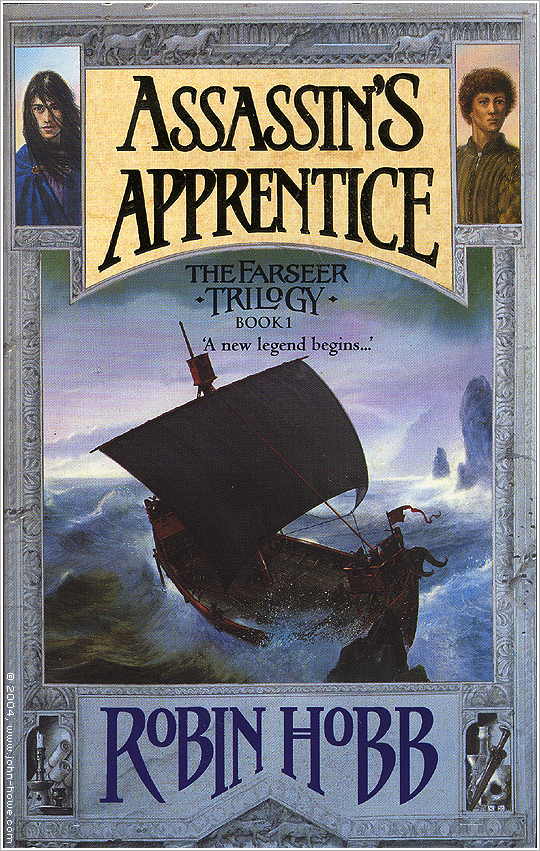
Assassin's Apprentice by Robin Hobb


In a faraway land where members of the royal family are named for the virtues they embody, one young boy will become a walking enigma.
Born on the wrong side of the sheets, Fitz, son of Chivalry Farseer, is a royal bastard, cast out into the world, friendless and lonely. Only his magical link with animals - the old art known as the Wit - gives him solace and companionship. But the Wit, if used too often, is a perilous magic, and one abhorred by the nobility.
So when Fitz is finally adopted into the royal household, he must give up his old ways and embrace a new life of weaponry, scribing, courtly manners; and how to kill a man secretly, as he trains to become a royal assassin.


How to review a book such as this? How can I originally say what has been said by many fans of the fantasy genre since this book was first published 18 years ago?

Well, I’m going to take a different tact. This isn’t a classic work of fantasy. Or rather, this isn’t just a classic work of fantasy. In my view, it is a classic work of literature that should be spoken about in the same conversations with Tolkien, something that transcends the fantasy genre.
Here’s why:
We follow a six year old boy - who we quickly find out is a royal bastard - as he is torn away from his mother and thrust to the attention of the royal court.
Fairly typical of a fantasy novel so far, I think you’d agree.
This boy, named Fitz by the Stable Master who is ordered to look after the youngster, quickly displays a semblance of an old, taboo magic. He begins training with the old royal assassin and finds himself embroiled in political machinations.
Old magic in a fantasy? Check.
Old mentor? Court intrigue? Check and check.
I could go on. There is no hiding what the book is or where its roots begun and neither should there be. If the above is enough to put people off reading it then more fool them. (No pun intended)
Fitz is our main character and is exceptionally well realised, as you may expect when the book is written in first person. The real skill that Hobb has though, is in making you forget the method of narration and invoking such strong feelings for each and every character. Prince Verity is one of the most stoic and noble characters you will ever read - you will feel the loyalty and painful sacrifice of Burrich and the awful vindictiveness of Prince Regal. As for the Fool, well, you're better off discovering this delight for yourself. Having read the trilogy several times I still can’t pinpoint how she does this, but I can’t think of another first person narrative that has such strong characters throughout the cast.
Not that they are without issue, though. Fitz's decision making is somewhat.... questionable at times and once or twice it feels ever so slightly forced, as if to move the action along, but these are few and far between. The actions of Regal can also seem slightly over the top, at least at first.
The name of the novel itself could be off putting to the casual reader, one whose boat isn’t floated by the idea of assassins. Whilst it is a significant portion of Fitz’s life, it isn’t a major part of the book. It serves to move the plot to where it needs to go and to round out Fitz himself; but the amount of cloak, daggers and poisons is quite minimal.
But what makes me think even non fantasy fans would adore this book? Well, the prose is beautiful, in a way that I cannot do justice. Hobb reveals her world with such elegance and care that she elevates this to more than a fantasy epic. It should be looked at as a modern literary classic.

"I wonder if I can write this history, or if on every page there will be some sneaking show of a bitterness I though long dead. I think myself cured of all spite, but when I touch pen to paper, the hurt of a boy bleeds out with sea-spawned ink, until I suspect each carefully formed black letter scabs over some ancient scarlet wound."

I implore you to read this book if you haven’t already. If you’re a writer of any standard you could learn lots. If you’re an avid reader you won’t regret it. If you’ve not tried fantasy before, please think long and hard before dismissing this.
If nothing else, it’ll lead you to book two, Royal Assassin, which is one of the best books I’ve ever read.
 
--------------------------------------------------------------------------------------------------------------------------
About the reviewer:
Alex can be found in the rolling hills of Oxfordshire, splitting his time unevenly between fighting crime and raising two little boys (which is surprisingly similar). When he does find a spare moment he crams it full of fantasy or basketball, and due to rapidly ageing knees it's mostly fantasy these days. He's trying to learn the writing craft through sheer bloody mindedness and dreams of the day he has to do nothing else. If you're so inclined you can watch him stalk writers on Twitter - @shep5377

Neverwhere by Neil Gaiman


This review was originally posted on Fantasy Faction in November 2012.
 
“Dear Diary, he began. On Friday I had a job, a fiancee, a home, and a life that made sense. (Well, as much as any life makes sense). Then I found an injured girl bleeding on the pavement and I tried to be Good Samaritan. Now I've got no fiancee, no home, no job, and I'm walking around a couple of hundred feet under the streets of London with the projected life expectancy of a suicidal fruit fly.”

 
Poor Richard. It was always going to get worse before it got better.

Most of you are probably familiar with Neverwhere and the works of Neil Gaiman. Many of you are probably thinking – why review an old Neil Gaiman novel? We all know how good it is. Well, until a few weeks ago, I’d never read anything by Neil Gaiman. Shocking, isn’t it?

For those that aren’t familiar with Neverwhere – it follows the story of Richard Mayhew. A man who moves to London from a little town in Scotland, gets a pretty decent job and gets engaged to a (pretty horrible) woman. Mostly, his life is about as ordinary as he could want it to be. But one evening, when walking to a particularly important dinner reservation with his fiancĂ©e, Richard stumbles across a fairly bedraggled girl in the street. Her name is Door, and she’s from a place called London Below. Y’see, all this time Richard’s been living in London Above, but he’s about to find out what happens to the people that slip between the cracks…

First off, Neil Gaiman’s prose is superb. It’s fast-paced, bizarre and extremely clever. He uses the nuances of language to create sentences which tell mini-stories of their own. Almost every sentence could be ripped out of this book and used as a quote – it’s that good. It feels like this book is a tribute to the entire city of London. Although most of the novel takes place in the fictional world of London Below, the descriptions of the places and the way in which the characters see everything makes you wonder if this isn’t just Gaiman’s way of describing the London he sees, every time he’s there.

 
“There was no moon but the night sky was a riot of crisp and glittering autumn stars. There were streetlights too and lights on buildings and on bridges which looked like earthbound stars and they glimmered repeated as they were reflected with the city in the night water of the Thames. It’s fairyland, thought Richard.”

 
The plot of Neverwhere is mostly fairly standard stuff, with a bit of a Gaiman twist. Richard is quite a typical protagonist – most likely to help make him a lense to the weirdness of London Below for the reader. But it’s the side characters in Neverwhere which make this book shine. Hunter and her dream to defeat the Monster of London; the Marquis de Carabas and his razor-sharp wit; and perhaps most memorable of all – the villains, Mr. Croup and Mr. Vandemar. These two will stick out in my mind for quite some time as one of the greatest double acts I’ve ever read.
 

“There are four simple ways for the observant to tell Mr. Croup and Mr. Vandemar apart: first, Mr. Vandemar is two and a half heads taller than Mr. Croup; second, Mr. Croup has eyes of a faded china blue, while Mr. Vandemar's eyes are brown; third, while Mr. Vandemar fashioned the rings he wears on his right hand out of the skulls of four ravens, Mr. Croup has no obvious jewelery; fourth, Mr. Croup likes words, while Mr. Vandemar is always hungry. Also, they look nothing at all alike.”
 

I’m so glad I decided to finally read Neverwhere. It’s at times: hilarious, touching and terrifying. A novel absolutely brimming with creativity and wonderful writing. The ending was perhaps a bit rushed when compared to the rest of the book, but at the same time, I think it is ultimately the right ending. Reading Neverwhere has spurred me on to read everything else I can by Neil Gaiman – so next up, Smoke and Mirrors.

And if you should decide to dive into London Below, just remember two things: Mind the Gap, and perhaps most importantly, Beware of Doors.

Tuesday, 5 February 2013

The Eyre Affair by Jasper Fforde


Welcome to a surreal version of Great Britain, circa 1985, where time travel is routine, cloning is a reality (dodos are the resurrected pet of choice), and literature is taken very, very seriously. England is a virtual police state where an aunt can get lost (literally) in a Wordsworth poem, militant Baconians heckle performances of Hamlet, and forging Byronic verse is a punishable offense. All this is business as usual for Thursday Next, renowned Special Operative in literary detection, until someone begins kidnapping characters from works of literature. When Jane Eyre is plucked from the pages of Brontë's novel, Thursday must track down the villain and enter the novel herself to avert a heinous act of literary homicide.


After some careful prodding from a few people, I decided it was about time I gave Jasper Fforde’s Thursday Next series a go. There is no real way to summarise this book – it’s a whirlwind of ideas, genres and comedy. The Eyre Affair never confines itself clearly to one genre. It really is a book of pretty much every genre going – both through its style and content. The very nature of The Eyre Affair defies easy genre categorisation.

It has elements of the literary, science fiction, fantasy, crime, romance, comedy, thriller and more besides. It’s not a particularly long novel, but it packs a serious amount into its length and, for me at least, remains consistently entertaining.

The book is structured from the 1st-person point of view of the LiteraTec Detective Thursday Next. The main plot of the novel is mostly that of a crime thriller, following an overtly evil villain named Archeron Hades and his plot to become the most notorious criminal of all time. (On a side note, the names in this novel are all ridiculous – but that’s part of the joke. A personal favourite was Runcible Spoon. After all, Dickens gave us names like Ebenezer Scrooge, Martin Chuzzlewit and Barnaby Rudge.)

But really, the overarching plot is simply a vehicle for Fforde to show off his incredible imagination. This is an alternate history where something in time has gone seriously wrong. Science has developed to a point where the most ridiculous of inventions (no matter how scientifically amazing they may be) are seen as nothing particularly special. It takes something huge to get the bigwigs interested.

In Fforde’s world, books are the be all and end all. Every area of society is built on the importance of books, from the media, to the police; the government to entertainment. It’s a fun world to get caught up in – I found myself chuckling at lots of little references to other books.

The characters in The Eyre Affair are all fairly colourful. They’re deliberately over-the-top and felt like they were (in some cases literally) ripped from the pages of fiction. Grounding us in this bizarre world is the character of Thursday herself. In amongst the weirdness, Thursday constantly questions and explains to the reader what’s going on. Yes, there are a few big questions left at the end, but I suspect these will be expanded upon in the sequels. She is an entertaining character to have as the lens to this world; although she is more grounded than most, she still has a few quirky foibles of her own.

The Eyre Affair is a novel which complete defies all sense of logic and genre boundaries, and yet remains entertaining despite its completely wacky premise and utterly bonkers plot. It is a great introduction to a strange, alternate history where things are seriously wrong, setting up even greater things to come. It has thrilling moments, humour throughout and an exciting plot with a great climax. And it has the greatest version of Richard III I’ve ever come across. Lots of fun, and I’ll be reading the sequel as soon as I can.